What is a lead-lag pattern?
In perpetuals, price doesn't update everywhere at the same time. A lead-lag pattern is when a meaningful move appears on one venue (the leader) and then shows up moments later on another venue (the follower). That delay is your edge window.
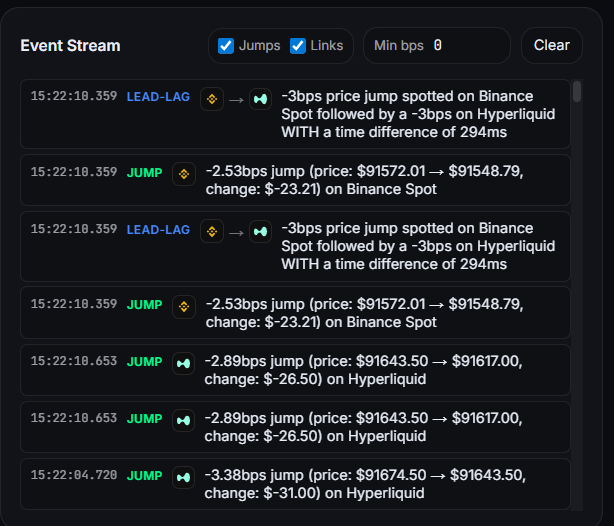
Why this matters
Most traders only see one book. Lead-lag is about cross-venue price discovery — knowing who sets the price first and who must react.
Why lead-lag happens (in plain English)
Lead-lag is usually a mix of:
- Liquidity concentration: the deepest venue absorbs flow and updates price first.
- Latency: feeds, matching engines, and routing differ across venues.
- Order flow: large market orders (sweeps) can move one venue before others react.
- Risk transfer: makers hedge across venues, pushing the follower to converge.
If you want the mechanics behind the numbers, see Lead-Lag Pattern Detection and the methodology.
A practical workflow for trading lead-lag
Rule of thumb (don't overcomplicate)
- Start with the leader: follow the venue that consistently moves first for your market.
- Confirm with order flow: use sweeps/absorptions to validate the move.
- Trade the convergence: look for the follower to close the gap (or fail and snap back).
- Size for slippage: the edge window is small; execution matters.
Next, pair it with signals: Sweeps and Absorptions: Reading Order Flow.
FAQ: what traders ask about lead-lag
Is lead-lag the same as arbitrage?
Not always. Arbitrage is a trade. Lead-lag is a market microstructure pattern you can use for directional entries, hedges, or arbitrage-style convergence.
Does it work on every coin?
The cleanest lead-lag shows up where liquidity is fragmented and flows are chunky. Start with majors, then validate per symbol.
What breaks the pattern?
Sudden liquidity pull, exchange-specific liquidations, or news shocks can flip who leads. That's why you track multiple venues, not one.