Two signals traders actually care about
In perpetuals, most price moves are a tug-of-war between aggressive market orders and passive liquidity. DOPE surfaces this as two easy-to-read concepts:
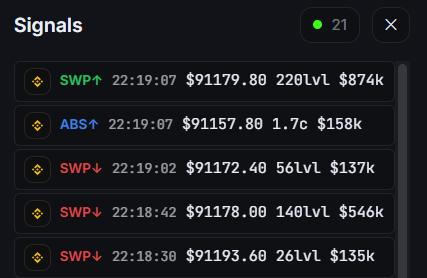
- Sweep: aggressive buying/selling that walks the book (market pressure).
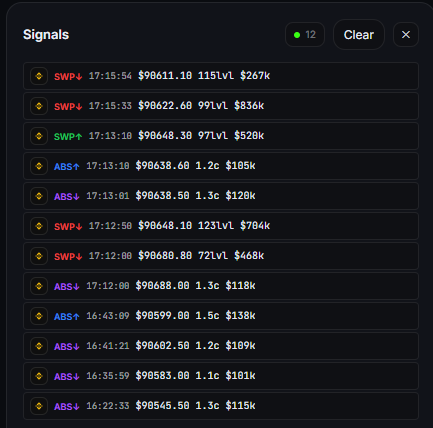
- Absorption: repeated aggression that fails to move price (hidden liquidity soaking it up).
What a sweep looks like
A sweep often shows up as a fast price jump with heavy taker volume. Sweeps matter because they often kick off lead-lag moves across venues.
Sweep checklist
- Did the move happen on the leader venue first?
- Is depth thin in the direction of the sweep?
- Did other venues start converging (followers catching up)?
What absorption looks like
Absorption is when aggressive orders keep hitting a level but price fails to break. It's a sign that a larger participant is providing liquidity (or defending an inventory level).
Common mistake
Traders treat absorption as a guaranteed reversal. It isn't. The better read is: if absorption breaks, the move can accelerate because the defending liquidity is gone.
Combine signals + depth + lead-lag (the robust way)
The most reliable workflow is to stack context:
- Lead-lag tells you who moves first.
- Sweeps/absorptions tell you why the move is happening.
- Order book depth tells you where price is likely to stall or accelerate.
To go deeper on the metrics, see Signals (Learn) and Order Book Depth (Learn).