What is order book depth?
Order book depth measures how much liquidity sits at different price levels away from the mid-price. Instead of only seeing the best bid/ask, depth tells you what's behind the curtain: stacked bids, stacked asks, and where liquidity is thin.
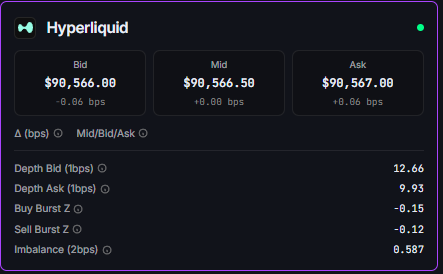
Depth is not prediction. It is context.
Depth doesn't tell you the future by itself. It tells you where the market is fragile versus supported — which changes how you size, enter, and manage risk.
What does 1 bps mean in depth charts?
bps means basis points. 1 bps = 0.01%.
In decimal terms, 1 bps = 0.0001. So if BTC is $100,000, then 1 bps is about $10.
Why depth in bps is useful
bps normalizes distance across assets and price regimes. A 10 bps wall means the same relative distance on SOL as it does on BTC.
Want the full definition of the metrics you see? Read Order Book Depth (Guide).
How traders actually use depth
- Find likely reaction zones: large depth clusters often behave like soft support/resistance.
- Spot thin liquidity: price can move fast through gaps, especially during sweeps.
- Improve execution: avoid chasing into thin books; size down when depth is low.
- Validate lead-lag: convergence is more reliable when the follower venue has depth to absorb the catch-up.
Depth pairs best with order flow. Next: sweeps and absorptions.